All about product
 Reviews
 INSTRUCTION FOR USE
CAD/CAM Libraries
INSTRUCTION FOR USE
CAD/CAM Libraries

Product Description
Open Lock Transfer Modular Hex for Implant H2.43
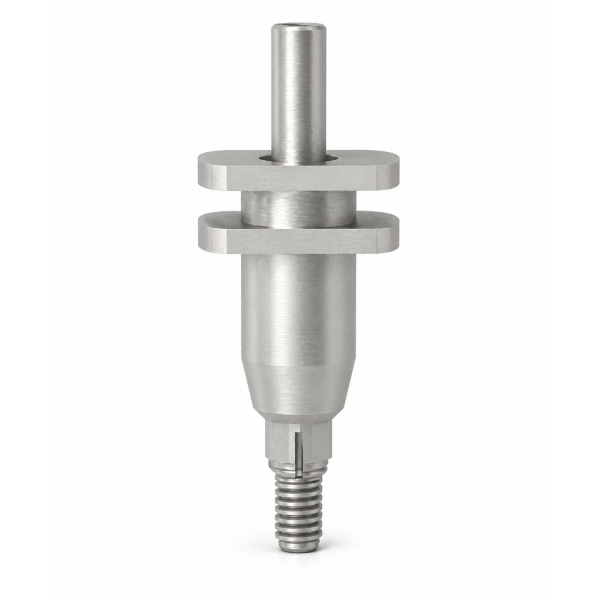
The Open Lock Transfer Modular Hex for Implant H2.43 is designed for accurate open-tray impressions of osseointegrated dental implants with an H2.43 internal hex connection. The transfer consists of three components: a cylindrical sleeve, a movable hexagon, and a fixing screw, providing enhanced flexibility and precision during impression procedures.
The transfer sleeve features a hollow supragingival structure with an internally positioned movable hexagon that adapts to implant positioning and facilitates accurate seating within the implant connection. The transfer sleeve together with the movable hexagon engages the implant with a secure locking effect and is fixed directly to the implant using a fastening screw (712012).
The modular hex design is especially recommended for clinical situations involving non-parallel implant placement, helping to improve impression accuracy and simplify removal of the impression from the oral cavity.
The transfer is installed and removed using a 1.27 mm hex driver (431412 or equivalent).
Manufactured from high-quality stainless steel, the transfer provides excellent dimensional stability, corrosion resistance, durability, and mechanical strength for clinical use.
Specifications
- Connection: Internal Hex H2.43
- Diameter: 4.5 mm
- Height: 13 mm
- Material: Stainless steel
- Components: Cylindrical sleeve
- Movable hexagon
- Fixing screw
Indications for Use
Intended for open-tray impression techniques with osseointegrated implants in all areas of the upper and lower jaw.
Especially recommended for:
- Non-parallel implant placement
- Complex restorative cases
- Multi-unit implant restorations
Compatible with:
- UNIQUE implants: 3.75 mm, 4.2 mm, 5.0 mm, 6.0 mm
- PERFECT implants: 4.2 mm, 5.0 mm, 6.0 mm
- PRIMA implants: 3.3 mm, 3.75 mm, 4.2 mm, 5.0 mm, 6.0 mm
- Other implant systems with internal connection H2.43
Sterilization
- The transfer is intended for single-patient use only.
- The product is supplied non-sterile and should be sterilized in an autoclave at 135°C (275°F) before use.
Advantages
- Modular movable hex design for improved flexibility
- Recommended for non-parallel implant positioning
- Accurate transfer of implant orientation and position
- Secure screw-retained fixation
- Compatible with H2.43 internal hex implant connection
- Precision-machined stainless steel construction
- Reliable seating within the implant connection
- Supports highly accurate open-tray impression procedures
- Designed for predictable restorative outcomes
- Easy handling using standard 1.27 mm hex driver

Reviews
There are no reviews for this product, be the first to leave your review.


General Information
Before using DMi products, the dentist, maxillofacial surgeon, or dental technician should carefully read the indications, contraindications, recommendations, warnings, and instructions, as well as all additional product information, including product descriptions, surgical and prosthetic manuals, catalogs, and related documentation.
DMi also recommends participation in relevant continuing education courses conducted on-site or remotely by authorized DMi specialists.
Detailed documentation and training information are available through authorized DMi representatives and on the company website:
www.dmimplant.online
Product Description
The Open Lock Transfer Modular Hex for Implant H2.43 (909945) consists of three components:
- Cylindrical transfer sleeve
- Movable hexagon
- Fixing screw (712012)
- Technical Specifications
- Diameter: 4.5 mm
- Height: 13 mm
- Material: Stainless steel
- Implant connection: Internal Hex H2.43
The transfer sleeve has a hollow supragingival structure designed to accommodate the movable hexagon component. The movable hexagon is inserted into the sleeve and together they engage the implant connection with a secure locking effect.
The transfer is directly fixed to the implant using the fastening screw (712012) and is installed and removed using a 1.27 mm hex driver (431412 or equivalent).
The modular movable hexagon design is especially recommended for clinical situations involving non-parallel implant placement, allowing improved impression accuracy and easier removal of the impression from the oral cavity.
Compatible with:
- UNIQUE implants: 3.75 mm, 4.2 mm, 5.0 mm, 6.0 mm
- PERFECT implants: 4.2 mm, 5.0 mm, 6.0 mm
- PRIMA implants: 3.3 mm, 3.75 mm, 4.2 mm, 5.0 mm, 6.0 mm
- Other implant systems with internal connection H2.43
Warnings
- The product is intended for single-patient use only.
- The product is supplied non-sterile.
- Sterilization in an autoclave at 135°C (275°F) before clinical use is recommended.
- The dentist, maxillofacial surgeon, or dental technician must be familiar with the clinical protocol for using implant impression transfers.
- Improper handling or incorrect clinical use may affect impression accuracy and prosthetic outcomes.
Indications
The impression transfer is intended for use in implant prosthetics to accurately transfer the position of osseointegrated implants from the oral cavity to a laboratory model using the open tray impression technique.
The modular movable hexagon design is recommended for cases involving non-parallel implant positioning.
Contraindications
- Lack of implant osseointegration
- Allergy or hypersensitivity to metals
- Trismus of masticatory muscles
- Limited mouth opening
- Increased gag reflex
Procedure for Use
Taking an impression with an open tray using a modular implant transfer allows highly accurate transfer of the implant position from the oral cavity to the working model, especially in cases of implant non-parallelism.
Clinical Procedure
1. Remove the gingiva former using a 1.27 mm hex driver.
2. Using the Holder Key for Abutment (431914), insert the movable hexagon into the transfer sleeve.
3. Install the transfer assembly into the internal hex connection of the implant.
4. Insert the fastening screw (712012) through the hollow opening of the transfer and secure the transfer to the implant using a 1.27 mm hex driver.
5. Cover the occlusal opening of the fastening screw with wax to prevent impression material from entering the screw channel.
6. Prepare the impression tray with an occlusal opening corresponding to the position of the transfer screw.
7. Take the impression using the “sandwich” technique:
- Low-viscosity material around the transfer
- High-viscosity material in the tray
- Medium-viscosity material may also be used when clinically appropriate.
8. Remove excess impression material from the occlusal access opening to expose the fastening screw.
9. After complete polymerization of the impression material, unscrew the fastening screw (712012) from the implant using a 1.27 mm hex driver.
10. Remove the fastening screw together with the movable hexagon from the transfer.
11. Remove the impression together with the transfer from the oral cavity.
12. Using the Holder Key for Abutment (431914), insert the movable hexagon into the transfer sleeve within the impression.
13. Connect the transfer to the corresponding implant analogue H2.43 (920038 or equivalent) using the fastening screw (712012).
14. Transfer the assembled impression to the dental laboratory.
15. The dental technician fabricates gingival imitation material around the implant analogue area and pours the impression using dental stone.
16. After complete hardening of the model, the fastening screw together with the movable hexagon is removed from the transfer.
17. The impression with the transfer is separated from the laboratory analogue.
18. The implant analogue remains embedded within the cast, accurately reproducing the intraoral implant position.
19. The resulting master model is used for fabrication of the implant-supported prosthetic restoration.
Sterilization
- The product is supplied non-sterile and must be sterilized before use in an autoclave at: 135°C (275°F)
- Single-patient use only.
Storage
Store in a clean, dry environment at room temperature away from direct sunlight and contamination.
Disclaimer
DMi Technology LLC. is not responsible for complications, injuries, or other negative consequences resulting from:
- Incorrect clinical indications
- Improper prosthetic technique
- Incorrect component selection
- Improper use or handling of instruments and components
- Failure to follow the instructions for use
The treating dentist, maxillofacial surgeon, and dental technician are solely responsible for appropriate clinical and laboratory application of the product.
DMi recommends appropriate professional training and participation in specialized DMi educational programs prior to use.
CadCam