All about product
 Reviews
 INSTRUCTION FOR USE
Video
CAD/CAM Libraries
INSTRUCTION FOR USE
Video
CAD/CAM Libraries


Product Description
Titanium Abutment Long for Implant H2.43
The Titanium Abutment Long for Implant H2.43 is a precision-engineered prosthetic component designed to support temporary and definitive implant-supported restorations. Manufactured from medical-grade Ti6Al4V ASTM F136 titanium alloy, this abutment provides exceptional strength, bio-compatibility, and long-term clinical reliability.
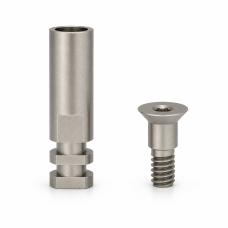
The abutment system consists of two components: the titanium abutment (501345) and fixation screw 701204. Featuring a straight profile with a 2.43 mm anti-rotational hex connection, the abutment ensures accurate positioning and a secure connection to compatible H2.43 implant platforms.
The protruding hexagon of the abutment is inserted into the implant's internal hex connection and secured using fixation screw 701204. Its extended 13 mm height provides additional prosthetic flexibility for cases requiring increased abutment height, soft tissue management, or customized restorative contours.
Once connected, the abutment serves as a stable prosthetic platform for a wide range of restorative procedures, including impression taking, laboratory fabrication, restoration fitting, abutment modification, and cementation of crowns and bridges.
Advantages
- Manufactured from medical-grade Ti6Al4V ASTM F136 titanium alloy.
- Long 13 mm abutment design for enhanced restorative flexibility.
- Anti-rotational 2.43 mm hex connection for accurate positioning and stability.
- Supports both temporary and definitive restorations.
- Suitable for impression taking, restoration fitting, and crown cementation.
- Excellent mechanical strength and corrosion resistance.
- Direct connection to H2.43 implant platform.
- Compatible with multiple implant diameters across UNIQUE, PERFECT, and PRIMA implant systems.
- Bio-compatible material suitable for long-term clinical use.
- Provides a stable prosthetic foundation for predictable restorative outcomes.
Specifications
- Connection: H2.43 Internal Hex 2.43 mm
- Diameter: 4.5 mm
- Height: 13 mm
- Material: Ti6Al4V ASTM F136 Titanium Alloy
- Abutment: 501345
- Fixation Screw: 701204
Compatible Implants
- UNIQUE Implants Diameters: Ø3.75 mm, Ø4.2 mm, Ø5.0 mm, Ø6.0 mm
- PERFECT Implants Diameters: Ø4.2 mm, Ø5.0 mm, Ø6.0 mm
- PRIMA Implants Diameters: Ø3.3 mm, Ø3.75 mm, Ø4.2 mm, Ø5.0 mm, Ø6.0 mm
Indications
- Temporary implant-supported restorations.
- Definitive implant-supported restorations.
- Cement-retained crowns and bridges.
- Single-unit and multiple-unit prosthetic restorations.
- Impression taking and restorative laboratory procedures.
- Cases requiring increased abutment height and restorative flexibility.
Sterilization
The product is supplied non-sterile and intended for single use. Prior to clinical use, autoclave sterilization at 135°C (274°F) is required according to validated sterilization procedures.

Reviews
There are no reviews for this product, be the first to leave your review.


Before using
DMi products, the dentist/maxillofacial surgeon/dental technician should
carefully read the indications, contraindications, recommendations, warnings
and instructions, as well as all other product information (product
description, surgical and reconstructive equipment description, catalog, etc.).
DMi also recommends attending our relevant continuing education courses, which
are conducted on-site and remotely by authorized DMi specialists. The above
documents and detailed information on the training courses are available from
the relevant representatives in different countries and on the company website:
www.dmimplant.online
Product
Description:
Titanium
abutment Long for implant H2.43 - the design consists of two parts: the
abutment itself (501345) with a hexagon protruding from it and a screw (701204).
These abutments are provided in straight, with an anti-rotation element -
hexagon 2.43mm. Titanium abutments are made of medical titanium alloy Ti6Al4V
ASTM 136. Diameter: 4.5 mm. Length: 13 mm. Direct connection to the implant
H2.43 with screw 701204. The protruding hexagon of the abutment (501345) is
inserted into the internal hexagon of the implant, and then the screw (701204)
is screwed through it into the internal thread of the implant. From this point
on, the structure can be used as a regular abutment and all the following
manipulations can be performed: - grinding, - making impressions, - giving to a
dental technician for fitting, - cementing crowns, etc.
It is used
together:
UNIQUE
Implant 3.75mmd, 4.2 mmd, 5.0, 6.0mmd,
PERFECT
Implant 4.2mmd, 5.0mmd, 6.0mmd,
PRIMA
Implant 3.3mmd, 3.75mmd, 4.2mmd, 5.0mmd, 6.0mmd.
Warnings:
The abutment
is intended for single use. The medical product in the package is not sterile. Autoclave
sterilization at 135 °C / 274 °F is recommended before use. The
dentist/maxillofacial surgeon/ dental technician should be properly familiar
with the technology of using the abutment.
Indications:
A titanium
abutment is a device used by implantologists to provide temporary and permanent
restorations on osseointegrated implants in the oral cavity.
Contraindications
1. Lack of
osseointegration of the dental implant;
2. Allergy
to metals;
3. Trismus
of the masticatory muscles,
4. Poor
mouth opening
5. Increased
gag reflex
Procedure
for use:
This method,
based on a fixed abutment, offers many possibilities. Cemented crowns and
bridges
Main
characteristics: fixed abutments, fixed prosthetics, cemented prosthesis,
prosthesis on an abutment. Sequence of
procedure:
- the
healing abutment is removed and the inner surface of the implant is washed;
- then, the
impression can be taken by all three methods, but it is preferable to use the
closed or open tray method with a fixed transfer on the implant (901545, etc.).
The fixing transfer (901545, etc.) is connected with a screw that passes
through the transfer to the implant;
- the open
part of the outgoing transfer is covered with wax;
- the
impression is obtained using the "sandwich", open or closed tray
method (using screw 712012 + 901745 for the open tray method);
- with the
closed tray method, the impression is removed from the oral cavity and the
screws securing the transfers (901545, etc.) are unscrewed, and then the
transfers are removed from the oral cavity; with the open tray method, the long
screw is unscrewed (while the impression is in the mouth), after all the screws
are released, the impression is pulled out. The transfers remain inside the
impression;
- with the
closed tray method, the analog (920038, etc.) is attached to the transfer using
the screws with which the transfer was connected to the analog;
- with the
open tray method, the analog (920038, etc.) is attached to the transfers using
the screws with which the transfers were secured to the implants through the
open part of the impression tray - the transfer is not removed from the
impression;
- with the
closed tray method, the transfer with the analog attached to it (900038, etc.)
is inserted into the hole it formed in the impression. If there are several
transfers, each of them should be inserted into the corresponding hole;
attention should be paid to the buccal-lingual position of the transfer bevel;
- the
impression is given to the dental technician;
- the
technician models the artificial gum and casts a plaster model in it together
with the analogs;
- the
technician attaches the abutment (501345) to the implant analog using a screw
(701204). The technician can grind, change the angle or height of the abutment
using a parallel meter. After this, the technician gives it to the doctor for
checking in the oral cavity. Or makes a crown or bridge prosthesis on the
processed abutment.
Recommended
metals for casting: titanium and its alloys, precious metals based on gold and
palladium, chromium and cobalt alloys.
Disclaimer:
DMi,
the importer and supplier of DMi products, is not responsible for
complications, other negative consequences or damage that may arise due to
reasons such as incorrect indications or prosthetic technique, incorrect
selection of the transfer or analogue, improper use or handling of instruments,
etc. The dentist/maxillofacial surgeon is responsible for any such
complications or other consequences. The dentist/maxillofacial surgeon/ dental technician must be properly trained in the
use of the technology in specialized DMi courses.
CadCam