All about product
 Reviews
 INSTRUCTION FOR USE

Product Description
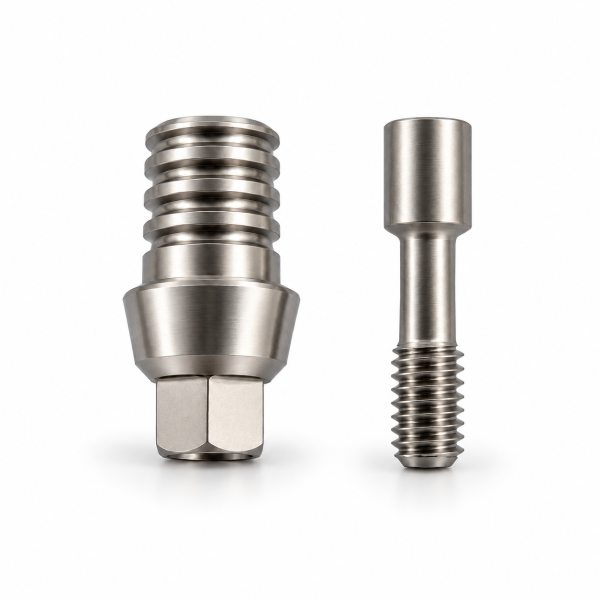
Titanium Base 1.5 for Implant Internal Hex H2.43
The Titanium Base 1.5 for Implant Internal Hex H2.43 is a prosthetic component designed to provide a titanium interface between a compatible dental implant and a custom restoration. It supports restorative fabrication using compatible CAD/CAM systems and laboratory components.
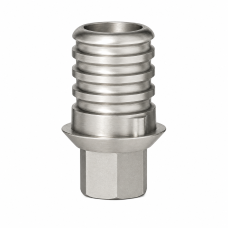
The base features a grooved restorative body, a tapered shoulder, and a hexagonal implant-engaging connection. The circumferential grooves provide surface geometry for integration with the restorative component, while the hexagonal connection establishes rotational positioning within the compatible implant interface.
Manufactured from titanium, the base combines strength, biocompatibility, and corrosion resistance for dental prosthetic applications. Its 1.5 configuration provides an additional option for restorative planning within the H2.43 internal hex system.
Key Features
- Designed for compatible Internal Hex H2.43 implants
- 1.5 configuration
- Titanium construction
- Grooved restorative body
- Tapered shoulder profile
- Hexagonal implant-engaging connection
- Central screw channel for prosthetic fixation
- Supports compatible CAD/CAM restorative workflows
Indications & Applications
Titanium Base 1.5 for Implant Internal Hex H2.43 is intended for:
- Fabrication of custom implant-supported restorations within the manufacturer’s approved indications
- Laboratory workflows requiring a titanium implant interface
- Digital restorative procedures using the corresponding component library
- Restorative treatment involving compatible H2.43 internal hex implants
Restorative Benefits
- Provides a titanium foundation for the custom restoration
- Supports defined rotational positioning through its hexagonal connection
- Allows restoration design to be adapted to the clinical case within approved limits
- Integrates into compatible digital and laboratory workflows
Compatibility
For use with the specified Internal Hex H2.43 implant platform. Confirm the exact implant system, fixation screw, driver, and CAD/CAM library before use. Connection size alone does not establish compatibility with every implant system.
Sterilization & Handling
- Follow the manufacturer’s validated cleaning and sterilization instructions before clinical use.
- Inspect the base, connection surfaces, and fixation screw before placement.
- Preserve the implant connection and screw seat during laboratory processing.
- Follow the specified surface-treatment, bonding, and tightening protocols.
Advantages
- Strong and corrosion-resistant titanium construction
- Grooved profile for restorative integration
- Hexagonal connection for rotational indexing
- Designed for coordinated clinical and laboratory use

Reviews
There are no reviews for this product, be the first to leave your review.


Titanium Base 1.5 for Implant Internal Hex H2.43
Intended Use
The Titanium Base 1.5 for Implant Internal Hex H2.43 provides an interface between a compatible dental implant and a custom prosthetic restoration, within the manufacturer’s approved indications.
For use by qualified dental professionals and trained dental laboratory personnel.
Compatibility & Selection
- Confirm compatibility with the exact implant model and prosthetic platform.
- Use only the fixation screw and driver specified for this titanium base.
- For digital fabrication, select the corresponding validated CAD/CAM library.
- Confirm that the engaging hexagonal design is approved for the planned restoration.
- The H2.43 designation alone does not establish compatibility with every internal hex implant system.
Preparation Before Use
- Check the product identification and packaging.
- Inspect the base and screw for damage, deformation, contamination, or defects.
- Do not use components with damaged connection surfaces, screw seats, or threads.
- Check the product label for its sterile or non-sterile status.
- Follow the manufacturer’s validated processing instructions before clinical use.
Laboratory Procedure
- Verify complete seating and rotational engagement on the compatible implant analog.
- Design the restoration within the approved dimensions, material requirements, and restorative indications.
- Modify the titanium base only where expressly permitted by the manufacturer. Do not alter the implant connection, screw seat, or screw channel.
- Where bonding is indicated, follow the approved surface-treatment and bonding instructions for the base, restorative material, and bonding agent.
- Protect the connection surfaces and screw channel from abrasive particles and bonding material.
- Remove excess bonding material and inspect the completed restoration for fit and unobstructed screw access.
- Process the completed restoration according to validated instructions before clinical placement.
Clinical Placement
- Inspect and clean the implant interface according to the implant system instructions.
- Position the restoration, aligning the hexagonal connection with the implant.
- Verify complete seating without force. Do not use screw tightening to pull an incompletely seated restoration into position.
- Insert the specified fixation screw using the correct driver.
- Tighten with a calibrated torque instrument to the manufacturer’s prescribed torque for the exact implant, base, and screw combination.
- Verify seating, stability, proximal contacts, and occlusion. Perform radiographic assessment when clinically indicated.
- Complete screw-access closure according to the approved restorative protocol.
Cleaning & Sterilization
Follow the manufacturer’s validated instructions for cleaning, disinfection, packaging, sterilization, and drying.
The prescribed sterilization procedure must include the cycle type, temperature, exposure time, and drying requirements. Confirm that processing is suitable for the completed restoration and its bonding materials.
A sterilization temperature alone is not a complete processing protocol.
Warnings & Precautions
- Secure small components against accidental swallowing or aspiration.
- Do not exceed the specified tightening torque.
- Do not combine components with unverified compatibility.
- Do not use in patients with known hypersensitivity to the component’s materials.
- Follow the product labeling concerning single use and reuse restrictions.
- Resolve any seating, fit, or fixation problems before completing treatment.