All about product
 Reviews
 INSTRUCTION FOR USE
CAD/CAM Libraries
INSTRUCTION FOR USE
CAD/CAM Libraries

Product Description
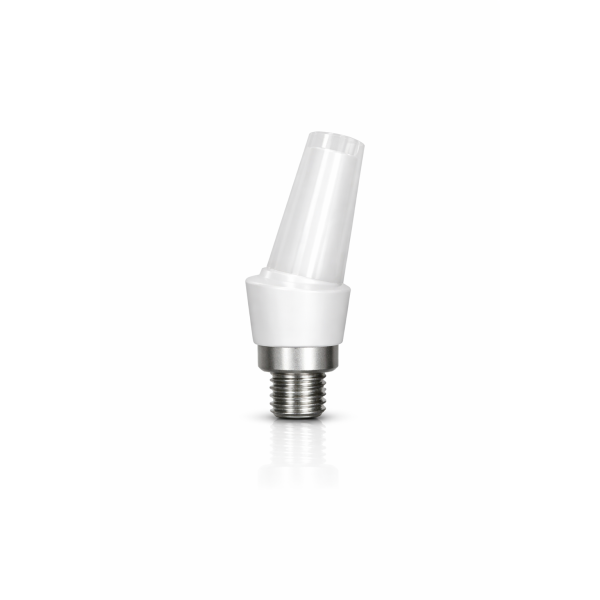
The Plastic Abutment Modular Hex for Implant H2.1 is a castable prosthetic component designed for the fabrication of custom cement-retained implant restorations. Featuring a modular two-piece design, the abutment combines the strength and precision of a titanium hex connection with the flexibility of a castable plastic sheath, enabling the fabrication of highly customized implant-supported restorations.
The abutment consists of a precision-machined titanium hex manufactured from medical-grade titanium alloy Ti6Al4V in accordance with ASTM F136 standards and a plastic sheath made from high-quality Delrin® (acetal resin). The component features a 2.1 mm hex connection with an anti-rotation element, a diameter of 4.5 mm, and a length of 8.5 mm, providing accurate positioning and stability during laboratory procedures.
Designed for use with titanium fixation screw 701203, the Plastic Abutment Modular Hex serves as a reliable foundation for the fabrication of custom cast abutments tailored to individual restorative requirements.
Key Features
- Designed for cement-retained restorations
- Modular two-piece construction
- Precision H2.1 mm hex connection
- Integrated anti-rotation element
- Diameter: 4.5 mm
- Length: 8.5 mm
- Titanium hex manufactured from Ti6Al4V ASTM F136
- Plastic sheath manufactured from Delrin® (acetal resin)
- Compatible with titanium fixation screw 701203
- Suitable for conventional casting procedures
- Intended for professional dental laboratory use
Advantages
- Combines the precision of a titanium connection with the flexibility of a castable plastic sleeve
- Anti-rotation design enhances positional stability during restoration fabrication
- Supports the fabrication of highly customized cement-retained restorations
- Provides accurate implant connection and predictable restorative outcomes
- Facilitates the creation of individualized emergence profiles and restoration contours
- Excellent laboratory handling and processing characteristics
- Cost-effective solution for custom prosthetic fabrication
- Modular design improves precision and versatility during laboratory procedures
- Compatible with multiple narrow implant platforms
- Designed specifically for professional dental laboratory applications
Compatible Implant Systems
- UNIQUE Implants Diameters: Ø3.0 mm, Ø3.3 mm
- PERFECT Implants Diameter: Ø3.75 mm
Sterilization
The product is supplied non-sterile and is intended for dental laboratory use only.
The titanium hex and plastic sheath are used during the fabrication of custom cast abutments. The final prosthetic restoration and all definitive components fabricated using this product must be cleaned and sterilized according to validated clinical and laboratory protocols before placement in the patient's mouth.
Applications
The Plastic Abutment Modular Hex for Implant H2.1 is used for the fabrication of custom cement-retained implant restorations. Its modular design enables dental laboratories to create individualized prosthetic solutions while maintaining precise implant connection geometry and reliable restorative performance.

Reviews
There are no reviews for this product, be the first to leave your review.


Plastic Abutment Modular Hex for Implant H2.1
Intended Use
The Plastic Abutment Modular Hex for Implant H2.1 is intended for the fabrication of custom implant-supported cement-retained restorations through casting procedures performed in a dental laboratory.
Contraindications
Do not use:
- With implant systems not listed in these instructions.
- If the component is damaged, deformed, or contaminated.
- As a definitive intraoral prosthetic component.
- If any component of the modular assembly is missing or damaged.
Warnings
- This product is intended for use only by qualified dental professionals and dental laboratories.
- The plastic sheath is intended solely for laboratory fabrication procedures.
- Use only original compatible components and fixation screws.
- Improper casting or fabrication procedures may compromise the fit, function, and longevity of the final restoration.
- Do not alter the geometry of the titanium hex connection.
Precautions
- Verify compatibility before use.
- Inspect all components prior to use.
- Ensure proper seating of the plastic sheath onto the titanium hex before fabrication procedures.
- Follow standard laboratory procedures for waxing, investing, and casting.
- Avoid damage to the anti-rotation feature and implant connection geometry.
- Maintain traceability of the product lot number in patient records.
Instructions for Use
Laboratory Procedure
- Verify compatibility of the abutment with the selected implant system.
- Assemble the plastic sheath onto the titanium hex component.
- Attach the assembled abutment to the implant analog or implant using titanium screw 701203.
- Verify complete seating and proper orientation of the anti-rotation feature.
- Modify the plastic sheath as required to achieve the desired restoration design.
- Complete waxing, investing, and casting procedures according to standard laboratory protocols.
- Finish and polish the fabricated custom abutment.
- Inspect the final restoration for fit, accuracy, and structural integrity before clinical use.
Clinical Procedure
Verify the fit of the fabricated custom abutment and restoration.
Connect the definitive abutment to the implant according to the implant system protocol.
Seat the restoration and verify occlusion, stability, and soft tissue adaptation.
Remove all excess cement after restoration placement.
Perform routine follow-up examinations according to accepted clinical protocols.
Sterilization
The product is supplied non-sterile.
The Plastic Abutment Modular Hex for Implant H2.1 is intended for laboratory use only and is not intended for permanent intraoral use. The final prosthetic restoration and all definitive components fabricated using this product must be cleaned and sterilized according to validated clinical and laboratory protocols before placement in the patient's mouth.
Storage
Store in a clean, dry environment in the original packaging. Protect from contamination, excessive heat, direct sunlight, and mechanical damage.
CadCam