All about product
 Reviews
 INSTRUCTION FOR USE
CAD/CAM Libraries
INSTRUCTION FOR USE
CAD/CAM Libraries

Product Description
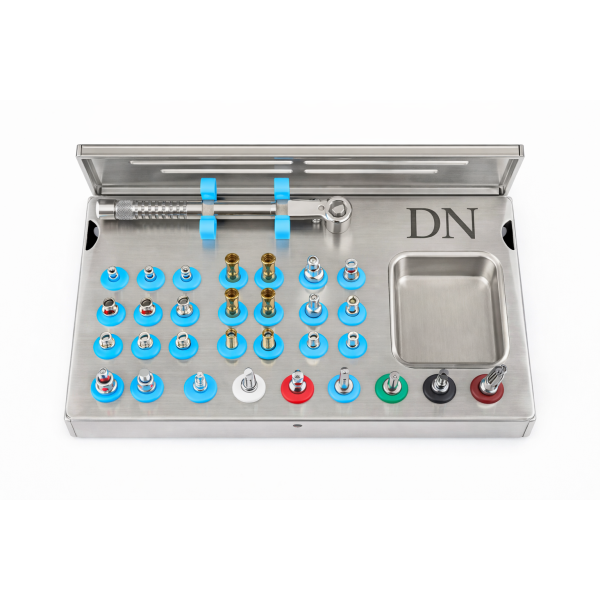
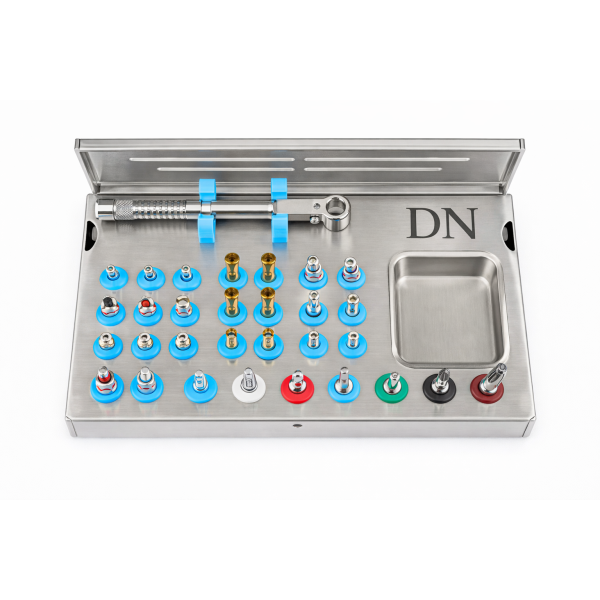
Surgical Set with Stopper
The Surgical Set with Stopper is a comprehensive implantology surgical kit designed for standard preparation of the implant bone bed and installation of two-stage dental implants. The set includes all essential instruments required for precise osteotomy preparation, implant placement, implant positioning, torque application, and prosthetic component handling during surgical implant procedures.
The surgical kit is intended for use with standard, narrow, and short implants ranging from 5 mm to 16 mm in length and from 3.0 mm to 6.0 mm in diameter within the DMi implant system, including: UTI, PFTI, PRTI, UMI, PMI.
The instruments for osteotomy preparation and implant installation are also compatible with implant systems utilizing internal hexagon connections of 2.1 mm and 2.43 mm, including: Green, Zimmer, Direct, MIS, Alpha Bio, Pal Top, BioHorizons, Cortex, AB and other compatible implant systems.
The use of drills with stopper locks allows controlled osteotomy depth preparation and helps reduce the risk of:
- Incorrect shaping of the implant bone bed
- Injury to important anatomical structures
- Mandibular nerve damage
- Excessive drilling depth
The surgical set includes precision instruments manufactured from high-quality medical-grade materials designed for excellent clinical durability, corrosion resistance, dimensional precision, and repeated sterilization cycles.
Set Components
1. Drills and Bone Preparation Instruments
- Pilot Drill Ø1.5 mm (401715)
- Marking Bur (403419)
2. Cylindrical Drills with External Cooling and Stopper Lock
- Ø2.0 mm drill
- Ø2.8 mm drill
- Ø3.2 mm drill
- Ø3.65 mm drill
- Ø4.2 mm drill
- Ø5.3 mm drill
3. Allen Keys – Standard Platform Hex 2.43 mm
- Long Manual Allen Key (431825)
- Short Manual Allen Key (430525)
- Machine Allen Key (430025)
4. Allen Keys – Narrow Platform Hex H2.1 mm
- Long Manual Allen Key (431821)
- Short Manual Allen Key (430521)
- Machine Allen Key (430021)
5. Allen Keys for Screws – Hex 1.27 mm
- Long Manual Key (431412)
- Short Manual Key (431112)
- Machine Key (430012)
6. Additional Instruments
- Drill Extension (431701)
- Parallelism Pins (451630, etc.)
- Manual Adapter for Allen Keys (440563, etc.)
- Universal Torque Wrench “Ratchet” (446302)
- Key for Removing the Abutment from the Implant (431912)
7. Drill Stoppers Included
- 5 mm stopper
- 6 mm stopper
- 7 mm stopper
- 8 mm stopper
- 10 mm stopper
- 11.5 mm stopper
Suitable for
- Standard implant surgery
- Narrow implant procedures
- Short implant procedures
- Two-stage implant placement
- Implant osteotomy preparation
- Implant positioning
- Implant insertion procedures
- Oral implantology applications
Specifications
- Product type: Surgical implant set with stopper system
- Implant compatibility: DMi implant systems
- Implant diameter compatibility: 3.0 mm – 6.0 mm
- Implant length compatibility: 5 mm – 16 mm
- Drill cooling: External cooling
- Drill system: Stopper lock controlled depth system
- Material: Medical-grade surgical materials
- Sterilization: Fully autoclavable
Indications for Use
Intended for surgical preparation of implant osteotomies and installation of compatible dental implants during:
- Implant surgery
- Implant site preparation
- Implant placement procedures
- Oral surgical implant procedures
- Prosthetic implant procedures
Sterilization
All instruments must be sterilized before use in an autoclave at: 135°C (274°F)
Advantages
- Complete surgical implantology kit
- Controlled depth osteotomy preparation
- Stopper system for improved drilling safety
- Reduced risk of anatomical injury
- Compatible with multiple implant systems
- Supports standard, narrow, and short implants
- External drill cooling system
- Precise implant positioning instruments
- Universal torque ratchet included
- High-strength medical-grade instrument construction
- Excellent corrosion resistance
- Fully autoclavable
- Designed for predictable implant surgical procedures

Reviews
There are no reviews for this product, be the first to leave your review.


Surgical Set with Stopper
Before using DMi Instrument, the dentist / oral maxillofacial surgeon must carefully study the indications, contraindications, recommendations, warnings and instructions, as well as all other product-specific information (product description, description surgical and reconstructive equipment, catalog, etc.) and fully included communicate with them. DMi also recommends visiting our corresponding refresher courses managed on site and remotely by authorized DMi specialists. Above mentioned documents and training details courses can be obtained from the relevant representatives in different countries and on the company website: www.dmimplant.online.
Product Description
It has the necessary instruments for the surgical stage of implantation:
- pilot drill with a diameter of 1.5 mm (401715),
- marking bur (403419),
- 6 cylindrical drills (2.0mm;2.8mm;3.2mm;3.65mm;4.2mm;5.3mm) with external cooling and with a stopper lock,
- 3 Allen keys with hexagon 2.43mm «standard platform» (431825 - long manual; 430525-short manual; 430025-machine),
- 3 Allen keys with hexagon H2.1mm «narrow platform» (431821 - long manual; 430521-short manual; 430021-machine),
- 3 Allen keys with hexagon 1.27 mm for screws (431412 - long manual; 431112-short manual; 430012-machine),
- drill extension (431701),
- 4 parallelism pins (451630, etc.),
- manual adapter for Allen keys (440563, etc.),
- 6 stoppers for drills diameter 5mm, 6mm, 7mm, 8mm, 10mm, 11.5mm,
- universal torque wrench "ratchet" (446302),
- key for removing the abutment from the implant (431912).
Intended use, indications for use
It is intended for standard preparation of the bone bed and installation of two-stage dental implants. It is used for standard, narrow, short implants from 5 to 16 mm in length and 3.0 to 6.0 mm in diameter of the DMi system (UTI; PFTI; PRTI; UMI; PMI). The instruments for bone preparation and implant installation are comparable with other systems with an internal hexagon of 2.1 mm and 2.43 mm (Green, Zimmer, Direct, Mis, Alpha bio, Pal top, Bio Horizon, Cortex, AB, etc.).
Advantages
The use of drills with stoppers allows you to exclude:
- incorrect shaping of the bone bed of the implant
- injury to important anatomical structures (mandibular nerve, etc.).
Contradictions
Surgical kit with stoppers is not used for installation of implants:
- one-piece implant,
- zygoma implant
Procedure for use
- Prepare a surgical kit with stoppers.
- Check the presence of all instruments in the kit.
Clean according to the generally accepted method:
- Soak in a solution of 3-6% hydrogen peroxide for 20 minutes.
- Rinse in running distilled water for 3 minutes.
- Ultrasonic cleaning in distilled water at a temperature of 60 degrees Celsius for 20-30 minutes.
- Soak in a special disinfectant solution for medical institutions for 30 minutes.
- Rinse in running distilled water for 3 minutes.
- Autoclave sterilization at 135 °C / 274 °F.
Bone preparation operation for implant insertion
Surgical set with stoppers is a set of instruments for bone preparation and installation of implants with internal connection of 2.1mmd and 2.43mmd and implant diameter of 3.0; 3.3; 3.75; 4.2; 5.0; 6.0; mm, which is comparable with other systems with hexagonal socket H2.1 mm and H2.43 mm (Zimmer, Green, Direct, MIS, Alpha Bio, Pal top, Bio Horizon, etc.).
Preparation of the bed for the bone implant depends on the type and volume of the jawbone, the method of dental implantation and the type of bone drills. The implant bed is prepared sequentially using drills of increasing diameter with indicator lines to determine the required drilling depth or using drill stops. All bone tissue preparation should be done with copious cooling of the drill and jawbone with sterile and cold saline and using the intermittent drilling technique. Intermittent drilling technique: the drill enters the bone and goes 2-3 mm into the bone. Then you make the opposite movement - the drill comes out of the bone. The cut bone comes out of the bone hole together with the drill, it must be removed with suction. Then the process is repeated until the planned drilling depth and diameter are obtained.
Drilling sequence
Mark the bone with a spherical bur (173419) to a depth of 2–3 mm. Then prepare the bone with a pilot drill (401720) or a 2 mm drill (401720, etc.). After preparation with the 2 mm drill (401720) to a depth of 8 mm, it is necessary to install a titanium depth gauge and, parallel to it, perform an X-ray examination in the prepared hole – a periapical (target) or panoramic image. (Titanium depth gauge (451630) and shortened titanium depth gauge (451030) for determining the depth and parallelism of the implant bone preparation during surgery. Considering that the thread pitch on the gauge is 1 mm, it is possible to determine with high accuracy how far we are from the nerve trunk, tooth, etc., and also to determine how parallel the drilling is in comparison with the teeth, implants, etc. And only after this is further preparation of the implant bone bed carried out. If you need to install several implants. It is recommended to maintain a minimum distance of 3.5 mm from each implant to the next. For accurate spacing and parallel placement, use the Parallel Gate (450023). Parallel Guide Set 420023 - The Parallel Guide is used to reliably parallelize the preparation between a pair of bone areas of the implant. After preparing the first implant bed with the first pilot drill, a parallel a guide that comes out in the form of a pin, and on the other side of this device there is a hole in which it is installed on the alveolar ridge, and through this hole the next bone bed of the implant is prepared. This allows for parallelism between a pair of holes, and then between a pair of closely spaced implants. In addition, this device allows for an accurate calculation of the distance between closely spaced implants, since the distance between the protruding pin and the hole in the device is 7 mm. Thus, when installing two closely spaced implants with a diameter of up to 4.2 mm using this device, when preparing the bone beds of the implant, we will get a distance of 3 mm between the implants, which will ensure sufficient bone volume between the implants for good osseointegration and a good aesthetic effect at the stage of prosthetics. The distance between the holes can be 10 mm if you want to install implants with a diameter of 5 mm or more and 12 mm if you want to install a bridge prosthesis with an intermediate tooth. During the drilling stage, it is necessary to constantly inspect and examine the bone hole or socket of the extracted tooth. To do this, use the implant bone depth gauge (450001), which is a pen with a two-sided working part. It is made of stainless steel. The working part has notches indicating the drilling depth into the implant bone bed. The first cut is 8 mm, then 10 mm, then 11.5 mm, then 13 mm, then 16 mm. At the end of the working part there is a hemisphere. On one side, its diameter is 1.9 mm, on the other - 3.0 mm. Using this gauge allows you to simplify the inspection of the walls and bottom of the prepared bone bed of the implant, determine the presence of perforation of the walls and bottom of the bone bed, and determine the integrity of the bone bed. mucous membrane of the maxillary sinus, measure the height of the alveolar ridge to the bottom of the maxillary and nasal sinuses on the upper jaw and the mental foramen on the lower jaw, take the necessary measurements during the operation and choose the tactics of further actions. After accurately determining the drilling depth, use the drill stoppers from the set. The stopper is suitable for all drill diameters. Continue drilling with an increase in the drill diameter. The last drill should be 0.5 mm smaller than the implant diameter. Drilling protocols with cylindrical drills are considered classic. This ensures a smoother and easier insertion of the implant into the bone, allowing for complete integration and immersion of the implant into the bone. This also prevents complications such as: - bone overheating, - bone fracture, - fracture of the implant hexagon, - jamming of the implant carrier or implant driver key in the implant hexagon.
Implant installation
The implant is installed using a 2.43 mm Allen key (431825, etc.) for implants with an internal hexagon H2.43 and with an internal cone + hexagon CH2.43 or a 2.1 mm Allen key (431821, etc.) for implants with an internal hexagon H2.1 and with an internal cone + hexagon CH2.1. The keys have high edges that help to visually determine the position of the implant hexagon. It is recommended to place the flat part of the veneer on the vestibular side so that standard abutments can be used. In addition, the keys have two round marks indicating the depth of implant immersion relative to the bone: the gingival os mark is at 3 mm, and the second is at 5 mm. After the implant is placed and the implant carrier is removed, the internal connection of the implant must be closed.
There are several approaches:
1. Two-stage implantation - installation of a screw-cover, which is in the sterile implant kit. Using a 1.27 Allen key (431412, etc.), take a screw from the sterile package and screw the cover into the titanium implant.
2. One-stage implantation.
The titanium healing abutment for implants is installed on the implant immediately after the implant is installed in the bone. Using a 1.27 mm Allen key (431412, etc.), screw the healing abutment into the titanium implant. The height of the abutment is selected based on the thickness of the gingival margin in each clinical case. Recommended: the height of the healing abutment should be at least 1 mm higher than the gingival margin, and the healing abutment should not come into contact with antagonists and adjacent teeth.
Warnings
The medical product in the package is not sterile. Autoclave sterilization at 135 °C / 274 °F is recommended before use. The dentist/maxillofacial surgeon should be properly familiar with the technology of using the Surgical Set with stopper. The drills in the set should be replaced when their cutting efficiency decreases. It is recommended to change the drills after 30-50 drillings.
When the cutting efficiency of the bone drill decreases, undesirable complications occur:
- large collateral edema of soft tissues;
- severe postoperative pain;
- an increase in dead bone cells in the prepared bone bed of the implant and, as a result, rejection of the implant;
- a fracture of the drill;
- a crack or chip in the jawbone, etc.
Disclaimer
DMi, the importer and supplier of DMi products shall not be held responsible for complications, other negative consequences or damages that may arise due to reasons such as incorrect indications or surgical technique, incorrect choice of implant or handling, improper use or handling of instruments, etc. The dentist/oral and maxillofacial surgeon is responsible for any such complications or other consequences. The dentist/oral and maxillofacial surgeon must properly instruct and inform the patient about the operation, handling and necessary care of the device, as well as any known risks associated with the device.
CadCam